“There’s no dog food or human food, it’s all just…FOOD…” ~Melanie Fox
I have always given my recipe out for free because basic nutrition is a DOG GIVEN RIGHT FOR ALL! I am a firm believer that a gently cooked food made with love, right at home, is the key to longevity. So here I give to you, my tried and true, lab & trial tested, holy grail of a recipe that is as easy as it is delicious! (so I’m told) You can also substitute the vegetables in this recipe using my Veggie Blend to make it even easier!
Things I always keep in mind when creating recipes for my dogs and others are:
Is it sustainable? Is this something I can keep up with when life gets hectic or tough? After a solid 16+ years I can confidently say that I have never had an issue knocking out this recipe for my dogs. I say “It’s as easy as Hamburger Helper!” which is funny because I’ve never even made hamburger helper!
However, while the Gen Z’ers say: “Wait, what’s that?” the point is, that it is easy! And while it may look fun to collect a huge cart full of veg and organ meat, grinding everything together meticulously. Its highly unlikely you will be willing to keep that up for the long haul. (or at least I wouldn’t!)
Do my dogs like it? With a simple recipe like mine, it’s not hard to make a batch and see if your dogs dig it. Some recipes will leave you with pounds of wasted food and time if your dog snubs it, but I can almost guarantee that your dog will love this one. I’ve personally never met a dog that didn’t love this recipe, especially once the Mineral Mix is added!
Is it meeting their nutritional requirements and balanced in fiber? In case you’re concerned, YES, my recipe meets the AAFCO nutritional requirements for All Life Stages. However, it does require the addition of my Mineral Mix, and that is because no matter how balanced a recipe is by a computer program, or how many organs you add, it is extremely difficult to guarantee certain vitamins and minerals in food. Especially with the state of our food (soil contamination, farming practices, etc.), it doesn’t contain nearly the nutrition that it would, and should, from an organic garden in your backyard. And even if you are using your own eggs, harvesting your own vegetables and getting meat from a local grass feeding organic farmer (snaps to you), you might find it difficult to find all of the items regularly, especially seasonally.
A good Mineral Mix comprised of all natural sources, makes for an easy to absorb cornucopia of health. The mix will also ensure that you have the perfect fiber ratio, making your dog’s poops the perfect firmness, and eradicating gross anal gland issues caused by loose stools. You all know what I mean!
This recipe has given me the maximum amount of years with my own dogs, and has been the best food even for my dogs with health issues (especially pancreatitis). Akeem and Ameera have only ever eaten my food, Akeem since 10 days old and Ameera since she was adopted at 3 months old! I don’t protein rotate, but you totally can! Akeem still spins for meal time, after 12 years!
Cooking for Your Dog at Home
Cooking for your dog is one of the absolute best things you can do for them. Eating whole, fresh, food is going to give them the best possible health for years to come. While every dog can benefit from a parent willing to cook, it is especially great for:
- Picky Eaters
- Dogs with Allergies
- Overweight Dogs
- Pancreatitis
- Diabetes
- Senior Dogs
- Dogs with Cancer
- All Life Stages
- Avoiding Recalls
- Bonding with your Dog Even More
When I first learned about home cooking, I read every book I could find, and then, tried every recipe I saw: stews, varying ratios, raw, grain free. I tried it all…tirelessly, so you don’t have to! On a Goldilocks style mission, I experienced issues with every method I tried, some too water heavy, some too low calorie…Stews caused the need for more frequent bathroom trips, raw feeding caused dampness (TCM) and digestion issues, no vegetables – caused imbalance in the dog’s microbiome, and grain free – left my dogs “starving” all of the time.
So finally, I created my own! My final recipe is the perfect amount of moisture, for optimal hydration, easy to digest and to make, for every dog across the board. I have never met a picky eater that didn’t scarf it down. It’s the only recipe I’ve fed my own dogs for the past 16 years and so many others!
But I keep reading that I have to feed raw, is that wrong?
As much as I appreciate the argument that dogs are indeed descendants of wolves (and agree), raw meat sold for human consumption is never going to simulate an animal that was just killed and is still pulsating with blood in the wild. It’s a well known fact that dogs are extremely domesticated (50% of them would not know how to survive in the wild!), so feeding them like their ancestors, is relatively outdated thinking. While I’m not completely against it (and yes, we can all have different opinions and still be friends!), and know that some people feel it is what is best for their dogs, I do warn that it needs to be done correctly, and in a balanced way. I find that many advocates of the raw movement have an “it’ll never be balanced” approach which is wildly reckless in a time where getting a balanced mineral supplement is as easy as a click of the mouse!
- Raw feeding is dangerous to the humans they share space with. Everything your dog licks, even their poop, has the potential to be contaminated with salmonella and other foodborne illnesses. While studies have shown that dogs are not effected by salmonella (unless possibly already very immune compromised), the salmonella will go in one end and out the other – continuing to live the dream in their poop! Who picks up their poop? Who plays in the yard where they leave it? We do! So, I personally opt out of raw for this reason alone. If you do feed it, just be very cautious , food safety is key and you might not want to snuggle up as close with your furbaby – WHICH IS AWFUL NEWS!
- It’s important to note that I have never seen any benefits of raw feeding over gently cooked recipes in any of my case studies, or personal dogs. It is also usually a very labor intensive, time consuming and costly experience that most people burn out on. It reminds me of when I decided to stop eating meat, and went straight to vegan, only to realize that it was really hard to live a regular lifestyle cutting so many ingredients out! I scaled back to pescatarian and have been there ever since. Some people can take on a large task and have better access to obscure ingredients and extra income to spend and the choice is yours. Some things to keep in mind are below.
- Make sure all of your organ meat is Organic: organ meat soaks up all of the pesticides from the feed, the antibiotics fed (if any) to the animal, and the organ I see used the most often, the liver, is what filters out all of the toxic things. So it’s extremely important to make sure these are sourced from a reliable and organic resources. Even when making treats!
- Bone meal is high in lead. So most raw feeders get their calcium from ground up bones. FYI if you’re buying a product that is fully prepped raw – beware of unground bones as sometimes the manufacturing process doesn’t get them all. I’ve seen numerous posts of chunks of bones. While raw bones are “okay” I prefer to stick to raw beef bones that are sliced, as I’ve seen dogs get obstructions from other bones, even raw. I don’t recommend bone meal for this reason and the only bones I feed are for recreational chewing (with the marrow removed to avoid a fatty overload).
- Eggshell calcium content is unreliable and eggshells are sprayed with propylene glycol, which is toxic to dogs. It’s hard for me to justify feeding an ingredient that has been treated with something we are avidly trying to avoid with home cooking! Eggshell quality also greatly depends on the experience in which it was created, hen’s health, feeding, etc. The shells, membranes and even the eggs can be nutritionally compromised from farming processes. So unless you have your own, or can get them locally, I don’t utilize the eggshells. Also, do opt for “pastured” when possible, and organic/free range at the very least.
- Raw diets lack vegetation. I find that most raw diets have very little, if any, vegetable or fruit quotient. The main issue with this is that is where all of our prebiotics originate from to keep a balanced microbiome (tummy bacteria), not to mention insoluble fiber to keep healthy poops! I always recommend at least 20% fruits and veggies but also stress that dogs do need to have the veggies gently cooked or pulverized since they don’t possess the enzymes to digest them fully. Raw veggies will go in one end and out the other! In the wild they would mostly get this part of their diet from the stomachs of the animals they ate, which means they’d be pre-digested!
So in summation, I personally can’t consistently execute a raw diet with all of the other things to do in life, and the risk doesn’t outweigh any kind of reward. If you are full steam ahead for raw, make sure to heed my warnings and always add a mineral supplement!
Auntie M’s Recipe
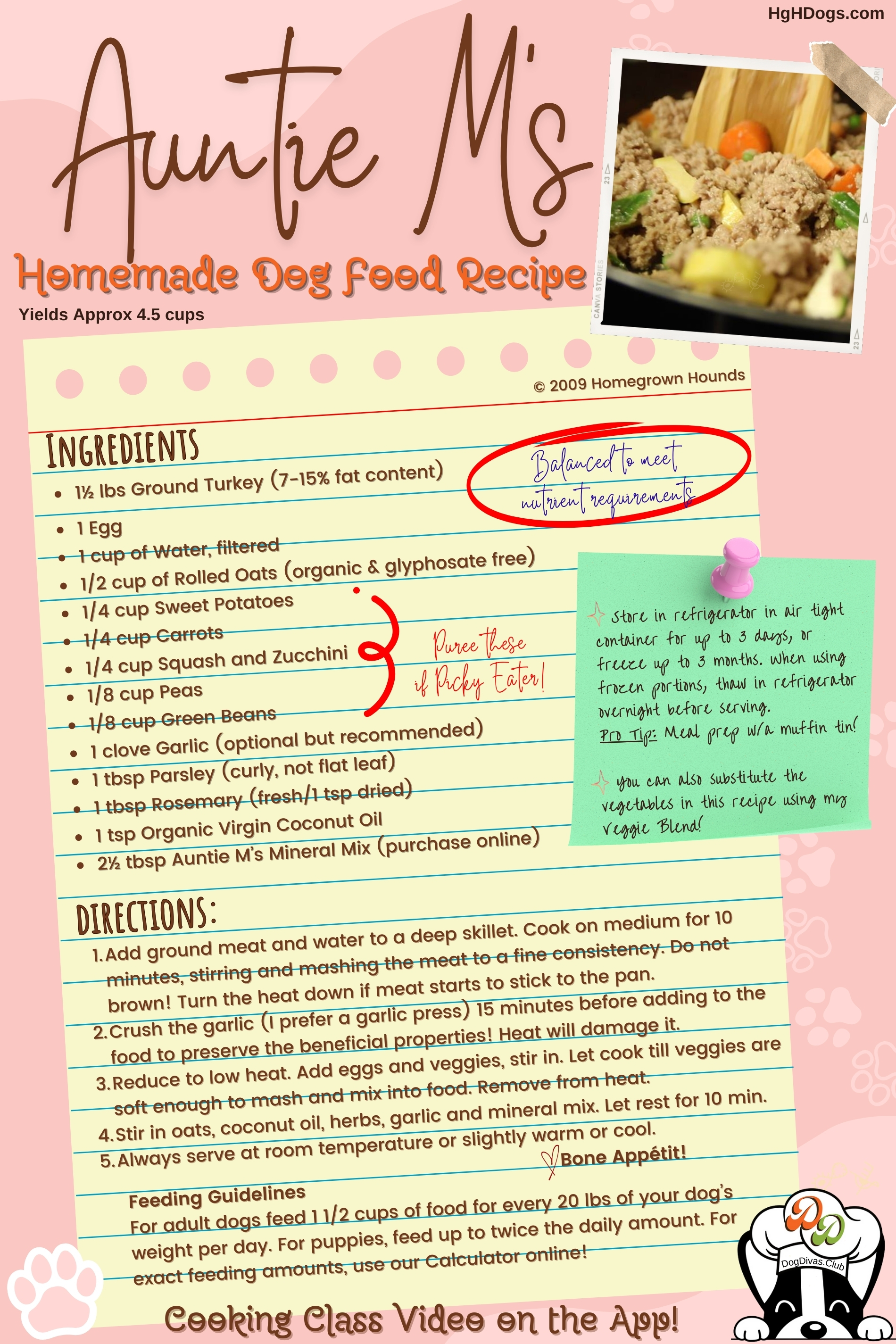
Below you’ll find some serving tips and tricks that I’ve culminated along the way. Make sure to use our Feeding Calculator to help you get the right serving for your pup. If you’re looking to shed some LBs for them, just put in their target weight! Remember the total amount is PER DAY, so split that in two if you’re feeding twice! This recipe is fit for all ages and activity levels.

My recipe is what I believe to be perfectly balanced in protein, fruits & veggies, grain and vitamins and minerals. While I know there are many recipes with far more protein, I have found that our dogs are domesticated to the point that feeding them an omnivore diet gives them more antioxidants and cancer fighting flavonoids.
The 10% grain (of which I only recommend rolled oats or quinoa) aids in the feeling in fullness, fiber and stamina for the dog’s day to day.
You can also substitute the vegetables in this recipe using my Veggie Blend™. Please Note: While I don’t recommend raw. If you want to use raw meat in this recipe, cook oats and vegetables with water before combining with meat.
General Feeding Guidelines
For active adult dogs feed 1 1/2 cups of food for every 20 lbs of your dog’s weight per day. For puppies feed up to twice the adult amount. For pregnant or nursing mothers feed up to three times the normal adult amount.
Use our Feeding Calculator to figure out exactly how much to feed your furbaby! Remember that some dogs, just like humans, metabolize differently, so if they need more/less, that is okay. This is a solid guide to start with.
Food can be stored in the fridge up to three days or in the freezer up to six months!
Tips for Cooking & Substitutions:
- Make sure to stir continuously (especially in the begging of the cooking process) for a finely ground food. Visit my Amazon Storefront for helpful tools. The more frequently you stir while cooking, the less chunks of meat you’ll have in your finished product. Which is great for small mouths and ease of measuring!
- Puree the Veg! For my super picky eaters and dogs who have a harder time digesting, I recommend (also do for my own dogs) blending or pureeing the veggies before adding to your food. You can do this one of two ways, purchase frozen veg/fruits and blend. Or you can chop fresh veg and blanch, but you MUST BLANCH VEGGIES before freezing, which is what you’ll be doing for your meal prep!
- Fat Content: When feeding growing and adult dogs it’s important to have a higher fat content. So look for ground meats that have a ratio of 85/15. You can lower this for older dogs and dogs prone to pancreatitis (to 93/7), but make sure you don’t go below less than 7%! Also, keep in mind, if you do feed a lower fat content, your dog will likely need to eat a larger amount. Feeding calculations are all based on an 85/15 protein. Ground meat is all I recommend, as we are not able to define the exact fat content otherwise. I do avoid the bagged ground meat, as it is ground too fine, and opt for organic when I can.
- Protein Rotating: You are welcome to rotate the ground protein in this recipe, as long as the fat content is listed and stays the same. I do not protein rotate, so don’t feel pressured to do so, it’s not required. Give yourself a break, you’re doing a lot already! Picky eaters may benefit from rotating. I recommend making a few batches of different proteins and prepping them so you can rotate daily, or at each meal time.
- Vegetables: Note that the total veggie content in this recipe is 1 cup, so if you are going to substitute veg, just make sure to stay in that measurement. Watch the video for how to!
- Grain: While I only recommend oats or quinoa for acceptable, easy to digest grains. You can absolutely sub in any grain you please, just keep it in this measurement zone and note that if the cooking ratio of grain-to-water and time is different – you will need to make adjustments to that.
- Meal Prep It! So I prefer to make a double batch and use a muffin tin to section out the food by 1/2 cup portions. Then I take them out and put them in a container in the freezer (takes up less space) and pull them down the night before to the fridge to thaw. This makes for a seamless transition from frozen to fridge, and the puck-like portions will thaw faster than in a tupperware.
Tips for Serving
- Ideally always serve food at room temperature. Microwaving the food to warm it up can be effective, but it’s a bummer to think you could be killing all the nutrients you just painstakingly put together! You can also heat up some water (a PYREX measuring cup in the microwave for a minute or two works well) and add it to the food. This will help keep your pup hydrated and warm up your munch at the same time. Just don’t add too much! Dogs should never be eating soupy foods. If your dog doesn’t mind it refrigerator temp, then it’s completely fine. I don’t warm up the food unless it’s frozen, but it does spend a bit of time in the bowl while I prepare their herbs and supplements which takes the chill off. If you need to cool it down after cooking, just toss in an ice cube! Let it cool, then remove.
- Feed twice a day. Feeding twice per day helps to give your dog added energy throughout the day and makes for a fun event two times a day! Plus splitting up meals can help to prevent bloat in larger dogs that require larger portions and give supplements and medications in a timely manner. Just take the total daily amount to feed your dog (from the calculator) and split it up into equal portions. Meals should be served 8 hours apart. Studies have shown that dogs who intermittent fast benefit from it just like humans!
- Add a probiotic! I recommend using a human grade probiotic, specifically Plexus Probio. It is the only probiotic that I’ve seen actual results from with yeast overgrowth issues and balancing the microbiome. The overgrowth of candida and yeast can cause so many symptoms, such as: itchy paws, ear infections, tear stains, UTIs and more. I’m sure you’re thinking, “isn’t home cooking enough?!” but unfortunately it’s just the base of holistic health and healing. Just like all of us, our stomachs get off balance which can lead to leaky gut. The good news is that once you get it back on track, a maintenance dose is enough to keep everything on the up and up in the digestive tract! This is one of my top added supplements, for the rest, check out the article on supplements! Give one pea sized scoop per 10lbs of dog, adjusting to more or less as flare ups arise.
- Supplement Feeding Trick – Picky Eaters. So a lot of people struggle to get supplements into their dog’s food and not get a turned up nose! I get it, I have the same issues. However, I have mastered the art of hiding supps! Just take about 1tsp of food and mix with all the supps. It might be pasty, but that’s okay! Then mix that with the rest of their food portion for the day. MIX IT LIGHTLY, I recommend using a fork even, to just fluff it together. Then put just a few pieces on top to keep the smell in the good zone. Dogs don’t have taste buds like we do, so they will rely on smell to decide whether or not to eat it. If your dog needs more coaxing, try some crumbled homemade chicken jerky. I highly recommend mine for the pickiest – it’s a lifesaver!
Read below for more info on my ingredients, ratios and more!
Home Cooking for Dogs 101
It used to be that telling someone you home cooked for your dog initiated an eye roll, or a convo about how you should just feed what’s in the bag because it’s “formulated” for dogs. However, nowadays, it’s all the rage! I have to tell you, I’m not sure which one of those concerns me more…

Most home cooks that I meet, have found a recipe on the internet or are just cooking up the ol’ chicken and rice and have a curious look on their faces as to why their dog “always seems hungry”. Well, bad news, they probably are! If you’re cooking up chicken breasts and white rice, you’re doing a disservice to your dog, wasting your own time, and staring down the barrel at a future vet visit. Sure, that’s still better than burnt up kibble…or is it? There is a reason for the “feed what’s in the bag” argument, and it’s along the lines of the ‘school lunch’. Is it processed, full of sugars, and carbs? Sure…but does it technically meet their daily dietary needs, sure does. Cringe at that for a moment, I will too…
This is why it’s important to make sure IF we are going to cook, we are doing it right! Why waste all of that time in the kitchen just to have Pookie starving to death and missing out on his required calcium intake every day? Let’s work smarter, not harder! Let’s go over some basics so that you understand how my recipe was built and the importance of each part.
Ratios: It’s more likely that you’re feeding too little protein, and far too much grains. (if you’re doing raw it’s probably too much protein, minimal veg and no grain) My ideal ratio is around 60% protein, 30% fruits & veg, 10% rolled oats (or Quinoa). There are suitable variations of this, but the key is BALANCE. All of these categories are important in some form, even minimal. I have never used a recipe with zero grain that gave my dogs the sustenance and satiated feeling they needed.
Fat Ratios: I’ve seen a crazy amount of misinformation regarding fat content over the last year and it’s extremely concerning as a canine nutritionist. Dogs require a specific amount of saturated fat, and unlike humans, it isn’t harmful to them (within the proper ratios of course). I see “professionals” suggest skimming the fat off and I literally scream at the computer! Let me bust a MYTH: You DO NOT need to wash your meat. Why? It’s an old school method (and if you want to, you can still) that is not really doing anything at all. You aren’t going to wash uncooked fat off of the meat, because it is intertwined. You could cut off meat, but if you’re buying large cuts of meat, I hope you have a method to calculate that fat percentage.
I cannot express to you how important it is that you
A.) Know what your fat ratio is in your protein. This is why I only recommend ground meat. You are getting multiple parts of the animal and a defined fat quotient. You can find butchers that grind it fresh, but wherever you get it, ground is best!
B.) Get a minimum of 7% if you have an active/adult dog. This level may vary depending on the recipe you choose, more meat, means leaner meat. This is why I urge you to stick to a recipe balanced by a professional! These are not easy calculations to make and most of us use computer programs and lab testing, feeding trials to ensure the nutrient content. I elaborate above under variations that can be safely made to my recipe with regards to fat conten. Chicken breasts are going to be far too lean to be your only protein source…and NO, you cannot just “add in coconut oil” to create your fat content.
I need to make sure you all hear me loud and clear on this one! Yes, there are some conditions where a lower fat is advised, but my recipe is well under that ratio already.
Minerals: This is where home cooking can get dangerous, and I want you all of take note of this at the very least. YOU MUST INCLUDE A MINERAL SUPPLEMENT WITH YOUR FOOD. There is unfortunately no possible way (a lot like humans) to compile a daily meal that contains all of the vitamins and minerals that your dog needs. Calcium being one of the most important, especially for growing pups. Now, that being said, there are a ton of products on the market claiming miracle properties. I prefer to use a mineral mix that is derived of all natural sources, like my Mineral Mix (avoiding bone meal and eggshells for the reasons listed above). Our bodies, and dogs, are better able to absorb the nutrients from whole sources rather than synthetic, giving them the best chance of optimal health. I know raw feeders will propose that organ meat can sub for these minerals, however I rarely see this done correctly (not that it can’t be) and the source of that organ meat, needs to be organic. Getting a liver from a non-organically raised animal is going to be full of toxins!
Now, there are a few things that can hinder mineral absorption, and I won’t go into them all here, but malabsorption is a very common one. So the mineral mix you choose for those dogs will impact them greatly. My Mineral Mix is available in our shop and is indeed, from all natural sources! It also adds the proper amount of fiber and balances this recipe so that your dog’s poops are easy to pick up and keeps those carpets clean!
Another very common issue when home cooking: I rarely see recipes with enough fiber content. This will lead to anal gland problems, digestive issues, and hungry hounds at your feet!
The Diference Between a “Balanced” Recipe and a Holistic One: With a sea of information and every individual posting a TikTok recipe, it’s hard to know what constitutes a worthy recipe. Once veterinarians started recommending BalanceIt, most people felt rest assured that they had a safe website to trust. Unfortunately BalanceIt isn’t giving you a nutritious balanced recipe, it’s giving you a fresh version of kibble. (it’s a holistic nutritionist’s nightmare!) Most recipe suggestions give a protein that is too lean, a subpar oil to add fat content and table salt. BalanceIt doesn’t even give a sliding bar for vegetation and their mineral supplement is fully synthetic. Not to mention over twice as expensive as the going rate (check out our cost comparison)! Plus, confusing measurements and single serving recipes. Ain’t nobody got time for that!
I personally feel that if we are going to put all of this time and effort into making sure our dog’s have the optimum nutrition, we need to make sure we have the best of the best. That is going to come from colorful veggies that are gently cooked (to aid in digestibility), balanced proteins, whole grains and a mineral supplement that does more than just check vitamin boxes. We are looking to provide a cornucopia of wellness in our dog’s bowl, so don’t settle for less!
One last thing, you’ll notice garlic is in my recipe and I’m sure most of you will scream, “but it’s on the poisonous list!”. I am well aware of that, however that came from a study where they fed whole heads of garlic to dogs and they got upset stomachs. I’m pretty sure anyone would get an upset tummy over that! Leave it out if you’re concerned, but every holistic vet recommends garlic, it’s natures antibiotic! Just make sure to crush it (I prefer a garlic press) 15 minutes before adding to the food to preserve the beneficial properties! It’s not released until it’s chopped or crushed and it’s not heat safe until 15 minutes after.
Homemade FAQs
”But I’m a vegetarian and I don’t know if I can cook meat for my dog!” Look, I’m in this with you. I stopped eating meat about two years before I started cooking for my dogs (the irony!). The thing is…you chose to share your life with a carnivore, and they do NEED MEAT. Now, if you feel very strongly, you CAN use the modified vegan recipe, but I implore you to keep the eggs at least! I know the meat industry is terrible, I am equally as disturbed by it and your feelings are 100% valid, I don’t want any of the animals to die or suffer ever…but our Furkids need/love/want meat. So if there’s a way you can reconcile with it, I hope you consider it!
What about my dog’s teeth? Don’t they NEED to eat kibble to keep them clean? This argument makes me cringe like no other… Have you ever felt dog food? It’s greasy, right? I mean you definitely wash your hands if you have to handle it. It’s greasy because all of the vitamins are killed in the high heat baking process and they are forced to spray them on afterwards.
Now, doesn’t that greasy crunch remind you of some Lays potato chips? If I told you that my dentist said: “just eat a bag of chips and don’t worry about brushing!” you’d laugh me out of the room! So why do we believe this nonsense when it comes to dogs?
Well, the buck stops here. Your dogs need their teeth brushed, even if they eat kibble. That is why vets do dental cleanings, because kibble doesn’t do it. Some dogs have better aligned teeth and the self cleaning action will keep them in decent shape. Some dogs chew a lot, but even with a dental stick they will favor one side and rarely stimulate the front gums or teeth. So…don’t worry about this when switching over, it’s another adventure for another day! But when you’re ready, go check out my article and video in my app!
Lastly, lets talk about the “table scraps” or “human food” statements of old. My reply to this, always is…”There is no dog food or human food, it’s all just…FOOD…” Who decided what food was to be for dogs? Well, it sure is hard to make a desirable product and a 40 billion dollar industry if anyone can just go to the store and make it themselves!
Sure, dogs need certain vitamins and minerals, but so do we! Yet we aren’t given rations of burnt toast in pre-proportioned bags to maintain our survival. That’s not to discount the importance of a balanced meal (the dogs AND you need your vitamin supps!), but those needs shouldn’t force us to feed a bag of poison either. Yes, I said it, what is in kibble IS POISON. Now, there are some better foods that are freeze dried, dehydrated and fresh/frozen. While I have issues with most of those too (you can read more on my app), what I’m referring to as poison is the classic kibble that comes in a bag, and likely doesn’t have an expiration date falling in the same decade (jk, or am I…).
So, why would your trusted veterinarian tell you to feed a bag of poison and NOT to share your fresh boiled chicken or fresh fruits with your dog? Well…there are a few reasons for this. Most veterinarians lack nutrition training. It is not customarily offered to them in school, requiring them to go for additional training and certification. That’s a big ask considering your vet is already your dog’s general practitioner, surgeon, and dentist. We would never ask a human doctor to wear that many hats! AND when they do get their nutrition education, their textbooks (yes I’ve read them) tell them to discourage homemade food because it is “bad”.
However, for our pets we don’t have a lot of resources for guidance, so this full weight falls onto the veterinarian to advice on ALL things dog. If you have a great vet, they will be honest with you about the things that fall outside of their expertise and refer you to a trusted nutritionist. However, some vets are still very old school, some make a profit from selling kibble (especially the prescription kind – read the article in my app!), and some are taught BY THE FOOD COMPANIES that home cooking is bad and should be avoided at all costs. A bit of a conflict of interest – don’t you think?!
That’s why we have to be better consumers, especially for our dogs, because we make their choices FOR them. You can find a list of ingredients to AVOID (aka poison) in my app so you always have it when shopping! download my app
So what is a dog mom/dad to do?! Become an educated advocate for your dog. Because being educated about why you are cooking and choosing this recipe (or another) is important! Always make sure you’re getting your information from trusted, professional sources.
“I’ve fed my dogs, and all of my foster dogs, this recipe for over 16 years and have always had spectacular results. I hope your dog loves it as much as mine!”
~Auntie M